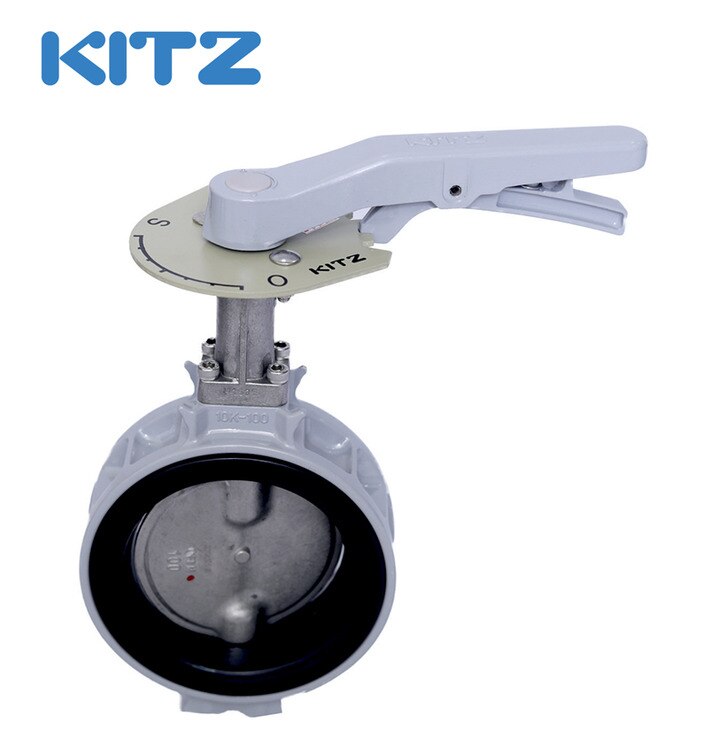


KITZ Corporation is one of the world's leading manufacturers of valves, known for its extensive range of high-quality products, including a strong portfolio of butterfly valves. Originating in Japan in 1951, KITZ has built a global reputation for reliability, innovation, and integrated production, from raw materials to finished goods.
KITZ Butterfly Valves: Overview
KITZ butterfly valves are highly regarded for their compact design, efficient flow control capabilities, and versatility across various industries. They are characterized by a disc that rotates a quarter turn (90 degrees) within the valve body to open or close the flow.
Key Features and Design Principles:
Compact and Lightweight: Their design minimizes face-to-face dimensions and weight, making them easy to install and suitable for systems where space is a premium.
Efficient Flow Control: Butterfly valves offer excellent flow regulation and throttling capabilities, making them suitable for both on/off and control applications.
Minimal Pressure Drop: When fully open, the disc's streamlined design results in minimal obstruction to flow,leading to low pressure loss.
Sealing Performance: KITZ often employs unique disc and seat designs (e.g., S-shaped discs, spherical seat designs) to ensure tight shut-off and extended service life for the rubber liners or PTFE seats.
Ease of Operation: Available with various operators, including levers (for smaller sizes), gearboxes (for larger sizes or higher torque requirements), and pneumatic or electric actuators for automated control.
ISO 5211 Compliant: Many KITZ butterfly valves feature actuator mounting pads that conform to ISO 5211 standards, allowing for direct and easy on-site mounting of various actuators.
Types of KITZ Butterfly Valves:
KITZ offers a comprehensive range of butterfly valves, catering to diverse application requirements:
Resilient Seated Butterfly Valves:
Material: Often feature bodies made of Ductile Iron, Cast Iron, or Aluminum. Discs are commonly Stainless Steel (SS304, SS316, SS316L) or Ductile Iron. Seats are typically EPDM, NBR (Buna-N), or PTFE.
Designs: Available in Wafer and Lugged types. Lugged type is suitable for dead-end service (where one side of the pipeline can be removed without affecting the other).
Series: Examples include the XJ series (Aluminum Butterfly valves) which are standard KITZ butterfly valves, and DJ series (Ductile Cast Iron Butterfly valves).
Characteristics: Known for excellent sealing, often with a patented S-shaped disc for uniform contact with the seat. Suitable for general purpose and low to medium-pressure applications.
High Performance Butterfly Valves:
Design: Often feature double or triple eccentric designs. These designs reduce friction between the disc and the seat, leading to lower operating torque, less wear, and extended service life.
Seating: Typically use PTFE or RPTFE (reinforced PTFE) seats for superior chemical resistance and higher temperature capabilities compared to resilient seats. Some also feature metal seats for extremely high temperatures or abrasive media.
Material: Commonly made with Carbon Steel bodies and Stainless Steel (SS304, SS316) discs and stems.
Pressure/Temperature: Designed for higher pressure and temperature applications (e.g., ASME Class 150,300, 600).
Series: Examples include KITZ's Class 300 High Performance Butterfly Valve (e.g., 300SCHBSL Series).
Specialized Butterfly Valves:
High Rangeability Butterfly Valves (HRDJ Series): Offer enhanced flow rate control, suitable for precise throttling applications.
Grooved End Butterfly Valves: Designed for quick installation in grooved piping systems, often used in fire protection and general utility lines.
Fully Lined Butterfly Valves: With linings like PFA for highly corrosive or abrasive media.
Common Materials of Construction:
Body: Aluminum die-cast, Cast Iron, Ductile Iron, Carbon Steel, Stainless Steel.
Disc: Stainless Steel (CF8M/SS316, CF8/SS304, SS410, SS420), Ductile Iron.
Stem: Stainless Steel (SS410, SS420, SS304, SS316).
Seat: EPDM, NBR, PTFE, RPTFE, Metal (for high-performance valves).
Applications of KITZ Butterfly Valves:
KITZ butterfly valves are used across a vast array of industries due to their versatility and reliability:
HVAC (Heating, Ventilation, Air Conditioning): Water lines, chilled water systems.
Water Treatment and Distribution: Potable water, wastewater, irrigation.
Oil & Gas: Refining, petrochemical plants, fuel handling (selection depends on fluid and conditions).
Chemical Processing: Depending on the material compatibility with the chemicals.
Power Generation: Water circulation, cooling systems, steam (specific types for steam).
General Industrial Applications: Manufacturing, pulp and paper, mining, food and beverage.
Fire Protection Systems: Often used as shut-off valves in sprinkler systems.
Specifications (General):
Sizes: From small (e.g., 1.5 inch / 40mm) to very large diameters (e.g., 24 inch / 600mm or even larger for some models).
Pressure Ratings: Typically range from PN10/PN16 (JIS 10K / ASME Class 150) for resilient-seated valves to Class 300/600 for high-performance valves.
Temperature Ranges: Depend heavily on the seat and body materials, ranging from -20°C to +120°C for standard resilient-seated valves, and significantly higher for metal-seated or PTFE-seated high-performance valves.
End Connections: Wafer, Lug, Flanged, Grooved.
Standards: Designed to meet or exceed international standards such as API 609, MSS SP-67, ASME B16.34, JIS,ISO, etc.